


Který laserový značkovací stroj by si měla vaše firma koupit: Fiber VS CO2 VS UV
In the packaging, component identification, and personalized gift industries, laser marking has become the undisputed standard for achieving permanent product traceability. A laser-marked code or logo does not fade, peel, or wash away the way ink-based alternatives can, and the non-contact nature of the process makes it suitable for an extraordinary range of materials and product geometries. From the unique device identification codes required on medical instruments to the serial numbers stamped into automotive engine components, from the date codes printed onto food packaging to the personalized engravings on a wedding gift, laser marking has displaced older identification methods across nearly every industry that requires permanent, legible, and tamper-resistant marking. Yet for businesses approaching this technology for the first time, choosing between vlákno, CO2, a UV laser marking machines often becomes a genuinely confusing decision, primarily because the differences between these three technologies are rooted in how each interacts with specific material types — a technical distinction that is not always communicated clearly during the sales process.
This confusion has real financial consequences. A business that purchases a fiber laser marking machine, assuming it will handle their wood packaging inserts, or one that buys a CO2 system expecting it to mark stainless steel components, will discover the mismatch only after the equipment has already been installed — an expensive and entirely avoidable mistake. Equipment of this category typically represents a meaningful capital investment, and a buyer who has not clearly understood which materials a given technology can and cannot address before finalizing their purchase risks a costly correction down the line, whether through equipment resale at a loss, the purchase of a second machine to address the original requirement, or ongoing reliance on an inferior alternative marking method that the original purchase was meant to replace.
Drawing on an analysis of real purchasing trends and production challenges reported by hundreds of international customers, this guide has been designed to cut through the technical confusion and help businesses identify the laser marking technology genuinely capable of delivering the highest return on investment for their specific application. Rather than presenting an abstract technical comparison disconnected from real purchasing decisions, this guide is grounded in the actual material categories, application scenarios, and business models that drive laser marking equipment purchases across global markets today.
This article is structured around two core questions that drive nearly every laser marking purchasing decision. The first is a fundamental technical question: which laser technology actually works on the specific materials a business needs to mark, since material compatibility is the single factor that most decisively narrows the field of viable options before cost, speed, or any other consideration enters the conversation. The second is a practical business question particularly relevant to smaller operations and entrepreneurs: how portable, lower-cost marking systems can generate meaningful revenue and a rapid payback period even for businesses without the capital or floor space for large industrial installations. Understanding both dimensions clearly is the foundation for making a laser marking equipment decision that serves a business well rather than becoming an expensive miscalculation.
Obsah
The Fundamental Differences Between the 3 Mainstream Marking Technologies
The single most important factor distinguishing fiber, CO2, and UV laser marking machines from one another is the wavelength of light each technology produces and how that wavelength interacts with different material types at the molecular level. This is not a minor technical footnote — it is the determining factor that decides, before any other consideration comes into play, whether a given laser marking technology can mark a specific material at all. This section examines each technology’s core material compatibility profile and the applications where it delivers genuine, irreplaceable value.
Vláknový laserový značkovací stroj
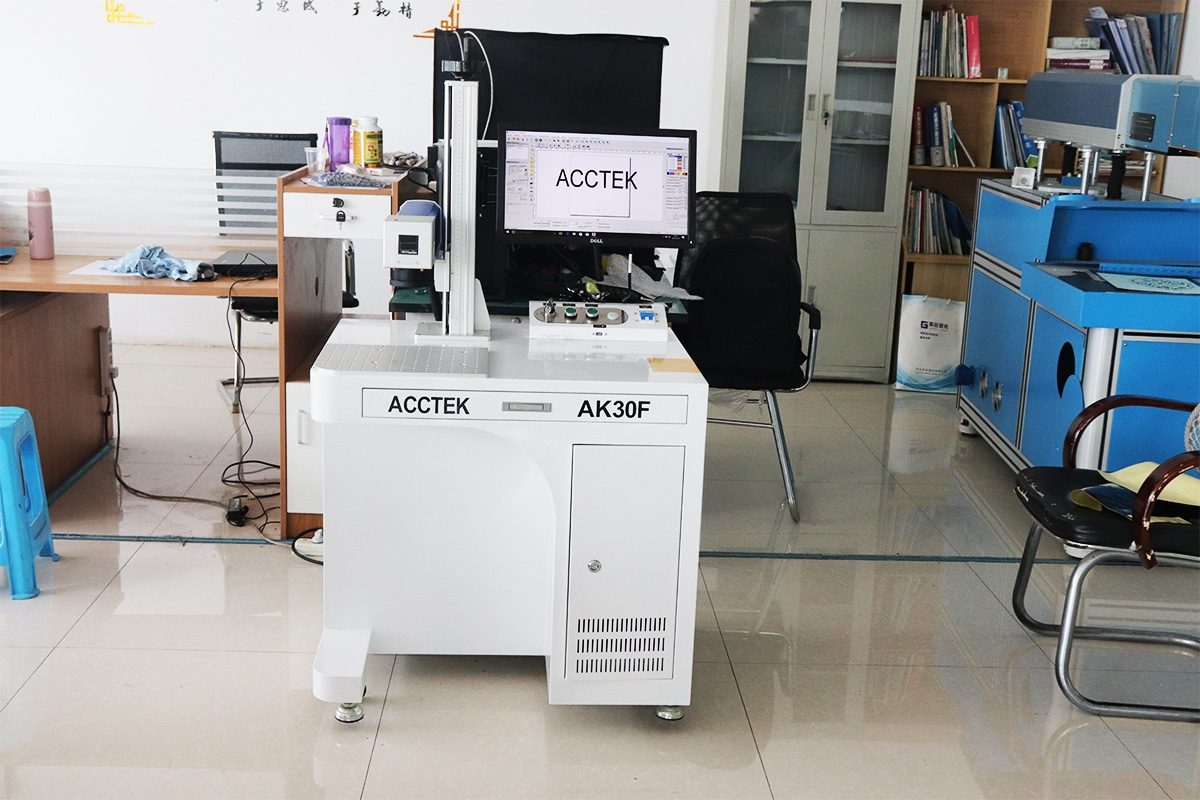
Fiber laser marking machines generate their beam using a solid-state laser generator that operates at a wavelength of approximately 1,064 nanometers, a wavelength that metals absorb with exceptional efficiency. This efficient energy coupling is precisely why fiber laser marking has become the dominant industrial standard for permanent identification on stainless steel, aluminum, brass, carbon steel, and titanium, producing high-contrast, wear-resistant marks through mechanisms including annealing, surface engraving, and color change marking, depending on the specific metal and the marking parameters applied.
Beyond pure metals, fiber laser generators also handle many hard plastics and coated surfaces effectively, including ABS, anodized aluminum, and certain engineering-grade polymers formulated with laser-marking additives. This combined metal and hard-plastic compatibility makes fiber laser marking machines the standard equipment choice for automotive component identification — engine parts, transmission housings, and safety-critical fasteners requiring permanent serial numbers and traceability codes — as well as for metal nameplates, tool and equipment identification, jewelry hallmarking, and electronics component marking, where hard plastic housings and metal contacts both require permanent identification within the same production line.
Fiber laser marking systems are available across a wide power range to match different application intensities, typically spanning from around 20W for fine, detailed marking on softer materials and thinner coatings, up to 100W or higher for faster marking speeds and the more demanding, deeper marking that heavy industrial applications on dense metals require. This power flexibility allows businesses to specify equipment precisely matched to their actual material thickness and production speed requirements rather than over- or under-investing in capability they do not need. For businesses whose core marking requirement involves metal components — automotive parts, metal nameplates, tool identification, or industrial equipment serialization — a fiber laser marking machine is, in the overwhelming majority of cases, the only technology genuinely capable of meeting that requirement efficiently and permanently.
CO2 laserový značkovací stroj
CO2 laser marking machines generate their beam at a much longer wavelength, approximately 10,600 nanometers, placing it in the mid-infrared region of the spectrum. This wavelength is strongly absorbed by organic and non-metallic materials — wood, leather, paper, cardboard, glass, and many plastics — but is poorly absorbed by bare metal surfaces, meaning that a CO2 laser generator is fundamentally unsuited to direct metal marking in the way that fiber laser technology is.
This material compatibility profile makes CO2 laser marking machines the natural and essentially exclusive choice for the packaging, gift, and craft industries working with non-metal substrates. Wooden gift boxes and packaging inserts mark beautifully with a CO2 system, producing a dark, high-contrast carbonized mark that reads clearly against the natural wood grain. Leather goods — wallets, belts, bags, and similar accessories — take CO2 marking exceptionally well, producing permanent branding and personalization without the need for ink or dye. Cardboard and paper packaging, glass drinkware and bottles, and a wide range of plastics round out the CO2 system’s core application territory, making it the standard equipment choice for packaging date coding, decorative branding on glass products, and the craft and personalization market broadly.
The fully enclosed CO2 laser marking machine configuration, which contains the marking process within a sealed enclosure and automatically exhausts fumes generated during marking, has become particularly important for this material category, since wood, leather, and many plastics release more substantial fumes and particulate during laser interaction than metal marking typically generates. This enclosed, fume-managed design supports a clean, safe working environment for businesses processing significant volumes of these organic materials, addressing both worker safety and workplace air quality considerations that are less pressing in pure metal marking applications. For businesses whose core marking requirement involves wood, leather, paper, glass, or general plastic packaging, a CO2 laser marking machine delivers the material compatibility and cost efficiency that no other laser technology in this comparison can match for these specific substrates.
UV laserový značkovací stroj
UV laser marking machines operate at a dramatically shorter wavelength than either fiber or CO2 systems, typically around 355 nanometers, placing them in the ultraviolet portion of the spectrum. This short wavelength carries a fundamentally different interaction mechanism with materials: rather than primarily heating the material to produce a thermal mark, as fiber and CO2 systems do, UV laser energy breaks molecular bonds directly through a photochemical process, often described as “cold processing” because it generates dramatically less heat at the marking site than longer-wavelength technologies.
This cold processing characteristic is precisely what makes UV laser marking the appropriate technology ceiling for applications demanding extreme precision combined with minimal thermal impact on delicate or heat-sensitive materials. Thin plastic films, fine electronic components, and delicate medical packaging materials can all be damaged, warped, or discolored by the thermal stress that fiber or CO2 marking would introduce, but respond cleanly to UV marking’s photochemical mechanism, producing fine, high-resolution marks without the heat-affected zone, melting, or material distortion that thermal marking processes risk on these sensitive substrates.
This precision and gentleness make UV laser marking machines the technology of choice for medical device packaging requiring traceability codes that must not compromise sterile packaging integrity, fine electronics components including the kind of small, heat-sensitive plastic housings found in phone chargers and similar consumer electronics, and any application demanding extremely fine, high-resolution marking — including micro-text, fine barcodes, and detailed graphics — on plastics and other materials where thermal damage would be unacceptable. For businesses whose marking requirements center on extremely thin, delicate, or heat-sensitive materials, particularly in medical packaging and precision electronics, a UV laser marking machine is the only technology in this comparison capable of consistently delivering the precision and material integrity these applications demand.
The three mainstream laser marking technologies are differentiated fundamentally by wavelength and the corresponding way each interacts with different material categories. Fiber laser marking machines, operating at approximately 1,064 nanometers, are the undisputed standard for metals and many hard plastics, making them essential for automotive components, metal nameplates, and industrial equipment identification. CO2 laser marking machines, operating at approximately 10,600 nanometers, are built specifically for non-metal organic materials — wood, leather, paper, and glass — making them the natural choice for packaging, craft, and gift industries. UV laser marking machines, operating at approximately 355 nanometers, deliver a cold processing mechanism ideally suited to extremely fine, precision marking on heat-sensitive plastics and delicate materials found in medical packaging and fine electronics. Identifying which of these three material compatibility profiles matches a business’s actual products is the essential first step in any laser marking equipment purchasing decision.
Speed, Precision, and Marking Depth
While material compatibility is the primary factor narrowing the field of viable laser marking technologies, businesses whose material requirements could theoretically be addressed by more than one technology — certain hard plastics, for example, can sometimes be marked by fiber, CO2, or UV systems depending on the specific formulation — benefit from understanding the practical performance differences between the three technologies in terms of marking speed, resolution, and depth. This section examines these performance dimensions to help buyers make an informed secondary decision once material compatibility has narrowed the field.
Marking Speed and Production Throughput
Fiber laser marking machines generally deliver the fastest marking speeds of the three technologies in the core material category of metals, owing to the high efficiency with which metals absorb the 1,064-nanometer wavelength and the high pulse repetition rates that modern fiber laser generators can sustain. This speed advantage makes fiber systems particularly well-suited to high-volume industrial production environments where marking cycle time directly affects overall line throughput, such as automotive component identification integrated directly into a production line, where each part must be marked within a tightly constrained cycle time.
CO2 laser marking machines generally mark at somewhat slower speeds than fiber systems on a like-for-like basis, though this difference is rarely a practical constraint in the application categories where CO2 technology is genuinely the appropriate choice, since packaging date coding, craft personalization, and decorative branding applications typically do not demand the same extreme throughput requirements as automotive or industrial metal component marking.
UV laser marking machines, while capable of extremely fine, high-resolution marking, generally operate at marking speeds that prioritize precision over raw throughput, reflecting the technology’s positioning toward applications where mark quality and material integrity outweigh sheer production speed as the primary requirement.
Marking Resolution and Fine Detail Capability
UV laser marking machines generally deliver the finest achievable marking resolution of the three technologies, a direct consequence of the shorter wavelength’s smaller achievable focused spot size and the cold processing mechanism’s minimal thermal spread around the actual mark location. This makes UV systems the preferred choice whenever a marking application genuinely demands the finest possible detail — micro-text below the resolution threshold that fiber or CO2 marking could reliably achieve, fine two-dimensional barcodes packed into very small surface areas, or intricate decorative patterns on small precision components.
Fiber laser marking machines also achieve excellent resolution on metal surfaces, generally sufficient for the great majority of industrial marking applications, including detailed logos, small serial numbers, and standard barcode and data matrix codes, though not quite matching the absolute resolution ceiling that UV technology can achieve on its optimal material range. CO2 laser marking machines, while capable of detailed work on organic materials, generally produce a somewhat coarser mark profile than fiber or UV systems due to the longer wavelength’s larger minimum achievable spot size, though this resolution level is entirely sufficient for the typical text, logo, and decorative marking applications that dominate CO2 marking’s core application territory in packaging and craft work.
Marking Depth and Permanence Considerations
Marking depth — how far into the material surface a given mark physically penetrates — varies meaningfully across the three technologies and has direct implications for mark durability under different service conditions. Fiber laser marking machines can be configured to produce marks ranging from shallow surface marking through deeper engraving, depending on the application’s durability requirements, with deeper engraving generally specified for components that will experience surface wear, repeated handling, or harsh environmental exposure throughout their service life.
UV laser marking, consistent with its cold processing mechanism, generally produces very shallow marks that affect only the immediate surface layer of the material, a characteristic that is entirely appropriate for its core applications where preserving material integrity matters more than achieving maximum mark depth, since the materials UV marking serves — thin films, delicate packaging, fine electronics — would often be damaged or compromised by the kind of deeper marking that fiber systems can achieve on robust metal substrates. CO2 marking depth on organic materials varies considerably by material type, with denser woods generally accepting deeper, more durable marks than thinner paper or lighter-weight packaging materials, where a lighter surface mark is both sufficient and more appropriate given the material’s inherent fragility.
Beyond the primary material compatibility distinction, fiber, CO2, and UV laser marking technologies differ meaningfully in marking speed, achievable resolution, and marking depth. Fiber laser marking generally delivers the fastest throughput on metal applications, making it well-suited to high-volume industrial production lines. UV laser marking achieves the finest resolution of the three technologies, serving applications demanding the most intricate fine detail. CO2 laser marking, while not matching the speed of fiber or the resolution ceiling of UV, delivers entirely adequate performance for its core organic material applications at a generally lower equipment cost. Businesses whose material requirements could theoretically be served by more than one technology should weigh these practical performance characteristics against their specific throughput and precision requirements when making a final equipment selection.
ROI: How Portable Marking Machines Help Small Workshops Turn a Quick Profit
Beyond the technical material compatibility question, a critical practical consideration for many businesses — particularly smaller operations, entrepreneurs, and workshops without the capital for large industrial installations — is how quickly a laser marking equipment investment can begin generating meaningful revenue. This section examines how portable and entry-level fiber laser marking machines have opened genuine, fast-payback business opportunities for small operators, using the personalized gifts market as a concrete illustration of this dynamic.
The Personalized Gifts Opportunity
The personalized gifts market represents one of the clearest and most accessible revenue opportunities available to small operators investing in laser marking equipment for the first time. Consumers across many international markets have shown sustained, strong demand for personalized products — engraved jewelry, custom-marked metal water bottles and tumblers, personalized pet tags, monogrammed metal accessories, and customized promotional items for corporate gifting — and this demand has proven remarkably resilient across gift-giving occasions throughout the calendar year rather than being concentrated narrowly around a single holiday season. Wedding favors, corporate recognition awards, baby gifts, anniversary presents, and graduation keepsakes each represent distinct, recurring demand cycles that together provide small operators with a relatively steady stream of order opportunities rather than a single concentrated seasonal spike that would leave equipment idle for much of the year.
A small operator entering this market with a portable or desktop fiber laser marking machine can begin producing market-ready, professional-quality personalized items almost immediately after installation, since the equipment requires no specialized industrial infrastructure, modest floor space, and a relatively short operator training period before achieving production-ready competence. The control software typically supplied with these systems is designed for accessibility rather than requiring extensive technical expertise, allowing a new operator to import a design file, position it accurately on the workpiece using a positioning system such as a red dot pointer, and complete a mark within a matter of seconds to minutes depending on the design complexity — a workflow that supports the kind of rapid, on-demand personalization that customers in this market increasingly expect, whether at a physical retail counter, a craft market booth, or in fulfillment of online orders.
Entry-level fiber laser marking machines, typically configured in the 20W to 30W power range, are well-suited to this application category, since personalized gift marking generally involves fine detail work on metal surfaces — engraved names, dates, monograms, and small decorative designs — rather than the high-speed, high-volume industrial marking that would justify investing in higher power configurations. This lower power specification not only reduces the upfront equipment cost relative to higher-power industrial systems but also tends to produce the kind of fine, controlled mark quality that personalization work on jewelry, small metal accessories, and similar delicate items genuinely requires, where excessive power could risk visible heat discoloration or surface damage on thinner or more delicate metal items.
The handheld and portable configurations available in this equipment category offer particular advantages for small operators serving markets that involve marking on irregular, large, or fixed objects that cannot easily be placed under a stationary desktop machine — engraving directly onto an already-assembled metal frame, a large trophy, or oddly shaped promotional merchandise, for example. This portability extends the addressable market for a small operator beyond flat, easily positioned items into a considerably broader range of personalization requests, increasing both the variety of products a single piece of equipment can address and the corresponding revenue potential from a single capital investment. A handheld system also opens the door to on-site personalization services — appearing at corporate events, trade shows, or markets to perform live personalization in front of customers, an experiential element that many consumers find appealing and that can command a price premium over simple mail-order personalization.
Calculating a Realistic Payback Period
The financial case for a small operator entering this market becomes concrete when the entry cost of equipment is weighed against realistic per-item revenue from personalized gift marking. Entry-level desktop and handheld fiber laser marking machines are available at price points considerably lower than industrial-grade systems configured for heavy manufacturing applications, placing the initial capital requirement within reach of individual entrepreneurs and very small workshops rather than requiring the kind of institutional capital that larger industrial marketing installations demand. Handheld configurations in particular span a wide price range depending on power, working area, and included features, with entry-level units positioned at a price point accessible to a single entrepreneur operating from a home workshop or a small rented studio space, while higher-specification handheld and desktop units with larger marking fields and additional automation features command a higher price reflecting their increased capability.
Personalized gift items typically command a meaningful price premium over their unpersonalized equivalents, and the marginal cost of adding a laser-marked personalization to an item already being sold — a name, a date, a short message — is minimal once the equipment is in place, consisting primarily of the brief marking time per item and negligible electricity cost, since fiber laser marking, much like the other technologies discussed in this guide, requires no ink, chemical consumables, or significant ongoing material cost beyond the equipment itself and routine maintenance. A pendant, bracelet, or metal accessory that might retail for a modest base price can often command a substantially higher price once personalized, and because the underlying blank item cost remains the same whether sold personalized or not, the incremental revenue from personalization flows almost directly to gross margin after accounting for the brief marking time involved.
This combination of relatively low upfront equipment cost and strong per-item margin on personalized goods allows many small operators to recover their initial equipment investment within a comparatively short operating period, particularly when selling directly to consumers through online marketplaces, craft fairs, or local retail partnerships where personalized items routinely command premium pricing relative to mass-produced alternatives. A small operator processing even a modest volume of personalized orders per week, at the kind of margin improvement personalization typically commands, can frequently recoup an entry-level equipment investment within months rather than years of operation — a payback timeline that compares favorably against many alternative small business equipment investments and that makes laser marking an attractive entry point for entrepreneurs evaluating their options in the broader personalized products and craft business space.
It is worth noting that the specific payback period any individual operator achieves will depend on factors including local market pricing for personalized goods, the specific equipment configuration and price point selected, marketing and customer acquisition costs, and the operator’s own production efficiency as they gain experience with the equipment. Prospective operators are encouraged to model their own realistic order volume and pricing assumptions against the specific equipment cost under consideration, rather than relying on generic industry figures alone, to arrive at a payback estimate genuinely representative of their own planned business operation.
Recognizing When a Portable System Is the Right Starting Point
For entrepreneurs and small workshops evaluating whether a portable or entry-level fiber laser marking system represents the right starting point, several practical indicators are worth considering. A business whose anticipated marketing volume is moderate rather than continuous industrial-scale production, whose core products are metal or hard plastic items suited to fiber laser technology, and whose available capital and floor space are limited relative to industrial installation requirements will generally find that a portable or desktop entry-level system delivers the fastest path to profitable operation without overcommitting capital to capacity the business does not yet need.
Conversely, businesses anticipating rapid scaling into high-volume contract manufacturing, requiring integration with automated production lines, or needing the kind of continuous, high-duty-cycle operation that a portable handheld system is not designed to sustain, should plan from the outset for a desktop or fully enclosed industrial configuration rather than starting with portable equipment they will quickly outgrow. The decision is not simply about minimizing initial cost but about matching equipment scale honestly to the realistic trajectory of the specific business being built, recognizing that under-equipping a genuinely high-volume operation can be just as costly, in lost throughput and operator strain, as over-equipping a modest operation that never needed industrial-scale capacity in the first place.
As a business’s marking volume grows and its product variety expands, the modular nature of laser marking equipment generally allows for a natural upgrade path — moving from a portable or desktop entry-level configuration toward higher-power, higher-throughput systems, or toward fully enclosed industrial configurations as production volume and quality control requirements justify the additional investment. A business that began with a 20W handheld unit serving local craft markets and online orders, for example, may find that as order volume grows into the dozens or hundreds of items per week, the cycle time and ergonomic demands of handheld operation begin to constrain throughput in ways that a desktop configuration with a larger working area and higher power would resolve more efficiently. This staged approach to capital investment, beginning with an accessible entry point and scaling deliberately as revenue and demand grow, mirrors the broader principle that should guide laser marking equipment selection across all three technologies discussed in this guide: matching the specific equipment configuration to genuine, current business requirements rather than overinvesting in capability that exceeds immediate needs, while remaining alert to the signals that indicate a scaling decision has become genuinely warranted.
Portable and entry-level fiber laser marking machines have opened a genuinely accessible, fast-payback business opportunity for small operators, with the personalized gifts market serving as a clear illustration of how relatively modest equipment investment can generate meaningful, sustained revenue. The combination of low entry cost, minimal per-item marginal cost, strong consumer demand for personalization, and the flexibility that handheld and portable configurations provide for marking irregular or large objects together creates a compelling case for small operators to enter this market with confidence. Businesses should evaluate their anticipated marketing volume, core material requirements, and available capital honestly to determine whether a portable entry-level system represents their appropriate starting point, with a natural upgrade path available as production volume and revenue grow over time.
souhrn
This article has provided a complete, practical framework for choosing between fiber, CO2, and UV laser marking technology, addressing the fundamental material compatibility differences that determine which technology can even perform a given marking task, examining the practical speed, precision, and depth performance differences relevant when more than one technology could theoretically serve an application, and exploring how portable, entry-level equipment configurations create genuine, fast-payback business opportunities for smaller operators entering this market.
The decision between fiber, CO2, and UV laser marking technology begins, and in most cases effectively ends, with an honest assessment of the specific materials a business needs to mark. Fiber laser marking machines, leveraging their efficient energy coupling with metals at the 1,064-nanometer wavelength, are the undisputed standard for metal components and many hard plastics, serving automotive, industrial equipment, and metal nameplate applications where no other technology in this comparison can compete on permanence, speed, or cost efficiency. CO2 laser marking machines, operating at the much longer 10,600-nanometer wavelength that organic materials absorb readily, are built specifically and essentially exclusively for wood, leather, paper, and glass, making them the natural and necessary choice for packaging, craft, and gift industries working with these non-metal substrates. UV laser marking machines, with their distinctive cold processing mechanism at 355 nanometers, occupy the precision ceiling of this comparison, delivering the minimal thermal impact that heat-sensitive plastics, fine electronics, and medical packaging applications specifically require.
For the relatively narrow set of applications where more than one technology could theoretically address a given material, the secondary performance characteristics examined in this guide provide useful additional guidance: fiber laser marking generally delivers the fastest production throughput, making it the natural choice for high-volume industrial lines; UV laser marking achieves the finest resolution of the three technologies, serving applications where the smallest, most intricate marks must remain crisp and legible; and CO2 laser marking, while not matching the raw speed of fiber or the resolution ceiling of UV, delivers entirely adequate performance for its core organic material applications at a generally more accessible equipment cost.
Beyond core technology selection, equipment scale and configuration matter just as much to a business’s ultimate return on investment. The personalized gifts market illustrates clearly how portable and entry-level fiber laser marking systems, available at price points accessible to individual entrepreneurs and small workshops, can generate meaningful, comparatively rapid payback by addressing genuine, year-round consumer demand for personalized metal goods with minimal marginal cost per item once the equipment is in place. Businesses evaluating their entry point into laser marking should resist the temptation to either overinvest in industrial-scale capacity that their current volume does not justify or to select the wrong core technology because it happened to be the option a particular supplier offered, rather than the one genuinely matched to their materials.
The most successful laser marking equipment investments share a common pattern: they begin with a clear-eyed, honest assessment of the specific materials and production volume a business genuinely needs to address, select the laser technology — fiber, CO2, or UV — that the material compatibility analysis in this article identifies as the correct fit, weigh the secondary speed, resolution, and depth characteristics where more than one technology remains viable, and scale the equipment configuration, from portable entry-level systems to larger industrial installations, to match real, current business requirements rather than speculative future capacity. Businesses that approach this decision with this level of discipline position themselves to capture the genuine traceability, branding, and personalization value that laser marking technology offers, while avoiding the costly mismatch between technology and application that confuses so many first-time buyers in this market.
Získejte řešení pro laserové značení
Choosing between fiber, CO2, and UV laser marking technology should be driven first and foremost by an honest assessment of the specific materials a business needs to mark, since this single factor determines which technologies are even viable before cost, speed, or any other consideration enters the decision — and working through this assessment with a manufacturer offering all three technologies under one roof leads to a far more objective, well-matched recommendation than working with a supplier who only sells a single technology and has an inherent incentive to recommend it regardless of fit.
AccTek Laser manufactures fiber, CO2, and UV laser marking machines across a broad range of configurations, from compact desktop and handheld fiber systems with power options spanning 20W to 100W, suited to everything from fine personalized gift marking to demanding industrial metal identification, through fully enclosed CO2 systems designed for safe, efficient marking of wood, leather, paper, and other organic materials with integrated fume extraction, to precision UV systems engineered for the heat-sensitive plastics and delicate packaging materials that medical and electronics applications demand. Its fiber laser marking machines achieve minimum line widths down to 10 microns and minimum character sizes as small as 0.15mm, supported by intuitive control software that allows new operators to reach production-ready competence quickly, while its handheld and portable configurations are specifically engineered for the on-site, irregular-object marking scenarios that the personalized gifts and field service markets demand. Its equipment is built using components sourced from established global suppliers, including recognized laser generator brands such as Raycus and IPG, high-speed galvo scanning systems, and reliable control software, supporting the stability and longevity that continuous industrial use requires, and its handheld fiber systems carry FDA certification supporting compliance requirements for businesses serving the United States market.
Customers evaluating a laser marking purchase can share their specific material types, anticipated production volume, and budget constraints to receive a technology and configuration recommendation matched precisely to their genuine business needs, rather than being steered toward whichever single product line a narrower supplier happens to offer. This consultation is supported by full pre-sales guidance, installation assistance, operator training, and ongoing after-sales technical support throughout the equipment’s working life, helping ensure that the equipment specification decisions made at the time of purchase continue to serve the business well as production volume and material requirements evolve.

Kontaktní informace
- [email protected]
- [email protected]
- +86-19963414011
- č. 3 zóna A, průmyslová zóna Lunzhen, město Yucheng, provincie Shandong.
Získejte laserová řešení